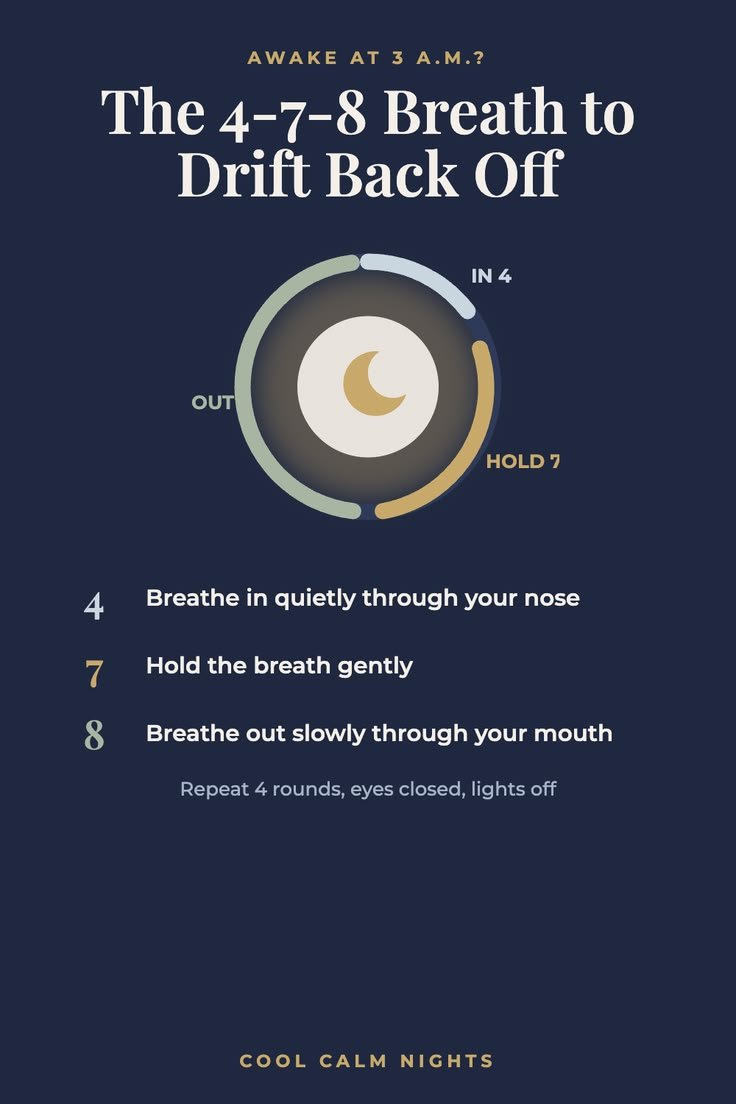
If you’ve ever stared at the ceiling at 3 a.m. with a racing mind and a body that won’t settle, welcome to the club. Middle-of-the-night waking is one of the most common sleep complaints in perimenopause and menopause. The good news is that you can do something about it without reaching for your phone or getting out of bed.

Why menopause wakes you up at night
Shifting hormones affect your body temperature, your stress response, and the parts of your brain that manage sleep. A small hot flash or a spike of stress hormones can nudge you awake, and once you’re up, your mind often jumps straight to tomorrow’s to-do list. The goal isn’t to force sleep. It’s to calm your body enough that sleep can come back on its own.
How to do the 4-7-8 breath
- Get comfortable. Lie on your back or side, lights off, eyes closed.
- Breathe in through your nose for 4 counts.
- Hold your breath gently for 7 counts.
- Breathe out slowly through your mouth for 8 counts, like you’re blowing through a straw.
- Repeat for 4 rounds. That’s it.
The long, slow exhale is the key. It helps shift your body out of “alert” mode and into “rest” mode. If holding for 7 feels like too much at first, shorten all the counts and keep the same rhythm. You’ll get more comfortable with practice.
Make it work even better
- Keep the lights off. Bright light, including your phone screen, tells your brain it’s time to wake up.
- Don’t watch the clock. Checking the time adds pressure and makes it harder to relax.
- Cool down first. If you woke up hot, kick off a layer or flip your pillow before you start breathing.
- Practice during the day. A few rounds before bed or during a stressful moment makes it feel natural at 3 a.m.
- Give it 20 minutes. If you’re still wide awake, get up, sit somewhere dim and quiet, and go back to bed when you feel sleepy.
When to talk to your doctor
Waking up now and then is normal. But if you’re regularly awake for long stretches, snoring loudly, or feeling exhausted during the day, talk to your doctor. Sleep problems in midlife are very treatable, and you deserve real rest.
The takeaway
Next time you’re wide awake at 3 a.m., skip the scrolling and try four slow rounds of 4-7-8 breathing. It’s free, it’s quiet, and it can help your body remember how to rest. Save the pin for your nightstand, and follow along on Pinterest for more real-life menopause tips.
This article is for general information only and isn’t medical advice.

- ►[Breathing Lamp for Mindfulness]:Science verified,4-7-8 Calming breath/5-5 Balance breath/4-4-4-4 Box breath,With Speak…
- ►[Small Lamp for Sleep Aid] :Soft Glow,Super Bright 100Lumens,Rechargeable 800mAh battery,4-8hrs working,Phone-free by R…
- ►[Fortune Teller Ball]:Toys speaker at the Bottom, Ask a YES/NO question and Touch orb’s top or Beat table nearby to awa…